Straight Cut or Dissolve: Two Ways to Leave a Scene
Straight cut or dissolve: learn how each transition shapes continuity, directs attention, and changes the viewer’s sense of time between scenes.
Should a scene end with a straight cut or a dissolve? A straight cut or dissolve changes how viewers meet the next image: a cut replaces one shot with another, while a dissolve briefly lets both images share the screen. Each can preserve continuity, but they give the passage between moments a different feeling.
A straight cut makes the next moment arrive
In a straight cut, the outgoing image ends and the incoming image begins without overlap. The join is direct, even when the action or location changes sharply. That directness can make a scene feel immediate: attention leaves one image and lands on the next.
A cut does not have to feel jarring. If a character turns toward a door and the next shot shows it opening, the movement gives viewers a clear thread to follow. A cut can also connect shots through a matching gesture, sound, shape, or direction of movement. The images change, but one element carries the viewer across the join.
For an editor, the useful question is not simply whether the cut is noticeable. It is whether the abrupt change serves the moment. A sudden cut from a quiet room to a crowded station can make the destination feel like an interruption. A cut between two calm views may pass almost unnoticed while keeping the scene moving.
A dissolve lets the outgoing image linger
During a dissolve, the outgoing shot gradually fades as the incoming shot appears over it. For a brief span, viewers can see both images at once. That overlap makes the transition visible and gives the change a softer, more continuous character.
A dissolve often suggests that time has passed, especially when the second image shows a later moment in the same place. But it has no fixed meaning. It can connect a remembered image to the present, associate two locations, or let one visual idea blend into another. The surrounding shots determine which reading makes sense.
The overlap also affects attention. A viewer may notice a face fading over a landscape, or compare the shapes of one room with another. If the images contain competing details, the viewer may have trouble deciding where to look. A dissolve is clearest when both images can share the screen without fighting for attention.
Continuity depends on what carries across the join
Continuity is the sense that images belong together in time, space, action, or thought. Neither transition creates it by itself. A straight cut can connect a continuous action cleanly; a dissolve can connect images separated by an interval. The editor chooses what relationship the viewer should perceive.
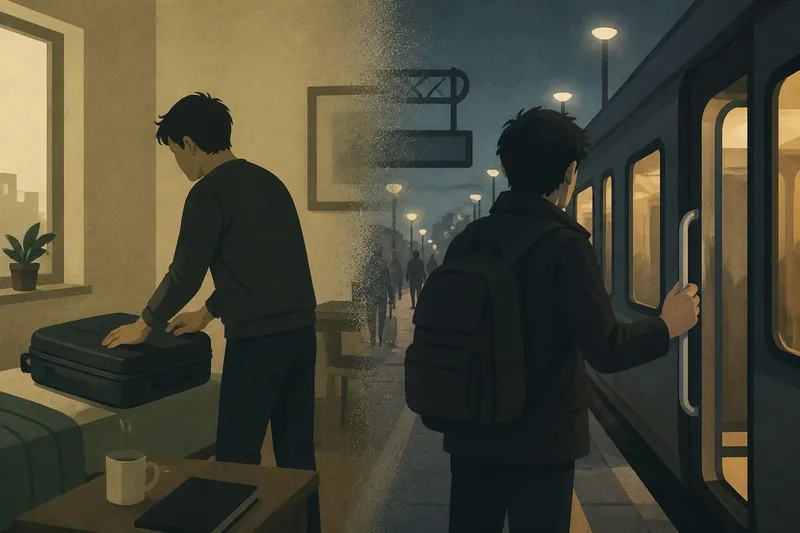
Say you are editing an invented scene: a traveler shuts a suitcase in a small apartment, then steps onto a train platform. With the starting images fixed, you place a straight cut from the suitcase closing to the traveler’s hand gripping a rail. The expected result is an immediate-feeling departure, with the hand movement carrying attention into the platform shot. Instead, you try a dissolve from the apartment window to the station lights. The expected result is a more noticeable passage between places, with the overlap linking them visually. The tradeoff is clear: the cut emphasizes the next action; the dissolve gives the interval or association more presence.
In both versions, the story remains unchanged. What changes is the transition’s emphasis: the cut stresses the next action, while the dissolve makes the passage more present. The observable difference is how viewers experience the arrival, not a change in what happened.
Choose the transition by the viewer’s task
Before choosing a transition, identify what viewers need to understand at that point. If the next shot advances an action, a cut may keep the action clear. If viewers should register an interval, a shift in memory, or a visual comparison, a dissolve may make that relationship easier to perceive.
- Check whether an action must read as continuous. If a hand reaches for a cup and the next shot shows it being lifted, choose a cut to keep the movement direct; if the action is meant to feel like a remembered impression, try a dissolve instead.
- Check whether a contrast should land at once. If a muted room gives way to a brightly lit street, use a cut for an immediate contrast; if the change should feel gradual, consider a dissolve.
- Check whether elapsed time matters. If the same table changes from empty to occupied, consider a dissolve to mark the interval; if viewers should arrive at the occupied table without lingering on the passage, use a cut.
- Check whether two images share a useful visual shape. If a round lamp and a full moon form a clear association, try a dissolve; if their overlap makes both hard to read, use a cut or choose a less crowded pair of images.
- Check whether dialogue or a sound cue bridges the shots. If the same line or sound continues across the join, retain it over a cut when the action should feel direct; if the audio changes with the image and the passage should be apparent, let the sound change support the dissolve.
- Check whether the overlap hides important detail. If a face or object becomes hard to identify during the dissolve, use a cut or simplify the images; if both remain legible and their relationship matters, keep the dissolve.
These are choices, not rules. A dissolve can carry a brisk association, and a cut can mark a quiet time jump. Let the intended effect guide the choice rather than relying on a habit tied to one kind of scene.
What should you ask before choosing a transition?
Does a straight cut always feel faster?
Not necessarily. A cut changes the image immediately, but pacing also depends on shot length, movement, and sound. A held shot after a cut can feel slower than a dissolve between brief images.
Does a dissolve always mean time has passed?
No. It can suggest elapsed time, but it can also connect a memory, idea, or visual resemblance. Look at the images and the surrounding scene to judge which relationship the transition supports.
Can a dissolve connect two continuous actions?
It can, though the overlap may make the action feel less immediate than a direct cut. If viewers need to follow exact movement, a cut may be clearer; if a soft passage matters more, a dissolve may fit.
What if the transition draws too much attention?
Ask whether viewers should notice the passage itself. If the transition interrupts an action that should feel unbroken, try a cut; if the overlap is meant to carry meaning, simplify the images so their relationship reads clearly.
Review the outgoing and incoming images together
Evaluate a transition in context, not as an isolated effect. Watch the outgoing shot, the join, and enough of the incoming shot to see where attention settles. Ask whether viewers follow an action, sense an interval, or notice a deliberate connection between images.
For a straight cut, check that the new image gives viewers a useful place to look. For a dissolve, check that the overlap supports the intended association rather than obscuring both shots. If the scene has dialogue or important sound, listen through the transition as well: audio may continue across the image change and soften a cut, or its change may make a dissolve feel more distinct.
The straight cut or dissolve decision is ultimately a decision about continuity: should viewers pass directly into the next moment, or feel the images overlap on the way there? Choose the transition that makes that relationship clearest, then judge it by the scene’s full flow rather than by the effect alone.